U.S. Weapons in Space: 5 Reassuring Facts You Should Know
The United States has publicly confirmed that it has deployed weapons in space, and the announcement has understandably raised questions around the world. The short answer to all of them is that there is no reason to panic.
The announcement is significant, particularly because the U.S. has previously kept much of its space-based military capability deliberately vague. But for ordinary people, like you and us, the immediate consequences are very limited.
Find below five reassuring facts that put the news into perspective.
1. U.S. weapons in space do not mean a war is about to start
The most important thing to understand is the difference between having weapons in space and actually using them.
In September 2026, the United States publicly acknowledged that it has deployed what it describes as on-orbit space-control weapons without revealing exactly how many systems are in orbit, when they were deployed or their precise capabilities. That secrecy is deliberate.
The purpose of revealing the existence of U.S. weapons in space is a familiar principle in military strategy. It makes potential adversaries aware that the U.S. can protect its space assets and respond if they are attacked by using their weapons in space.
2. “Weapons in space” does not necessarily mean missiles or nuclear bombs
The phrase itself sounds more dramatic than the reality may be. When people hear “ U.S. weapons in space”, they might imagine satellites carrying missiles or nuclear weapons orbiting Earth.
However, space-control weapons can include systems designed to interfere with, disable or defend against other spacecraft. Some can operate without physically destroying another satellite.
Satellites have long been used for communications, navigation, intelligence, weather monitoring and military operations.
The new development is the public acknowledgement of dedicated weapons in orbit, not the sudden discovery that space has become militarily important.
3. Your GPS, internet and everyday technology are not suddenly at risk
This is probably the question most people have: Could the U.S weapons in space affect my everyday life?
For now, there is no reason to expect it to.
Modern life depends heavily on satellites. They support navigation, aviation, shipping, weather forecasting, communications and many other services. But that doesn’t mean that one military confrontation in space would automatically switch off GPS or the internet.
Our infrastructure is made up of many different systems, including satellites, ground stations, fibre-optic networks and terrestrial communications.
A serious conflict involving space infrastructure could certainly cause disruption, particularly to systems that depend heavily on satellites. But that would require a significant escalation from the situation we are seeing today.

4. The biggest danger is not a “space battle” but debris
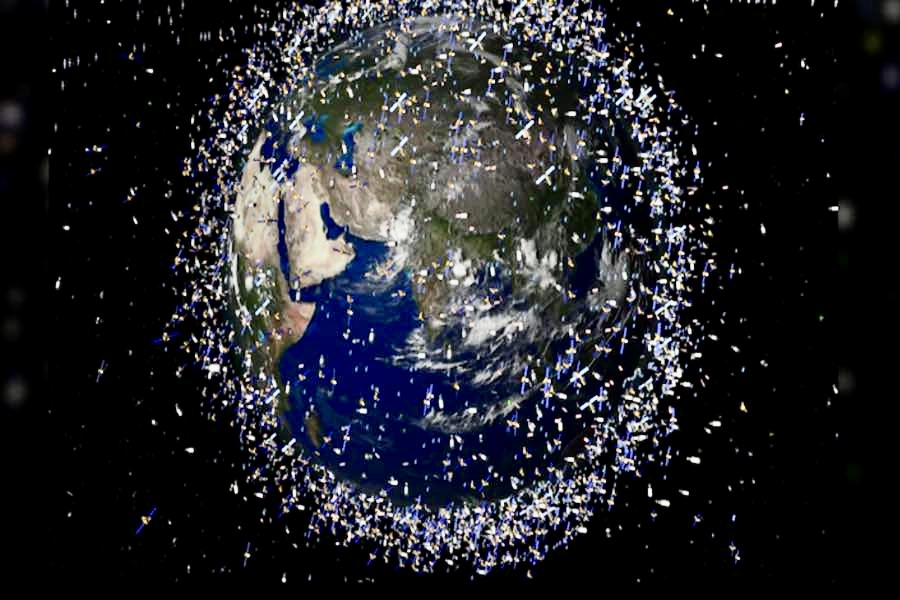
If there is one aspect of space warfare that genuinely deserves attention, it is space debris. Destroying a satellite can create thousands of fragments travelling around Earth at extremely high speeds And those fragments can then collide with other spacecraft, potentially creating even more debris.
Scientists have long warned about the possibility of a chain reaction sometimes referred to as Kessler syndrome. In a severe scenario, collisions could make some orbital regions increasingly difficult and dangerous to use.
The reassuring part is that this remains a worst-case scenario, not something currently happening on a global scale.
Countries also have a strong practical incentive to avoid creating large amounts of debris. The same orbital environment used by military satellites is also used by civilian and commercial spacecraft.
In other words, space is one place where destroying your opponent’s infrastructure can potentially create problems for yourself, too.
5. The weapons in space impact is longterm
The most important consequence of the U.S. weapons in space announcement may be geopolitical rather than technological.
The United States, China and Russia are all developing increasingly sophisticated capabilities for protecting their satellites and potentially interfering with those of an adversary. That creates the possibility of a space arms race.
And this is the part worth watching.
A country may describe a new system as defensive, while another country may see the same capability as offensive. That can create mistrust, competition and the risk of miscalculation.
There is also a particularly sensitive connection between space and nuclear security. Satellites can support early-warning, communications and intelligence systems. During a major international crisis, interference with those systems could make it harder for countries to understand what their opponents are doing.
Again, that does not mean a space conflict is inevitable.
It means that international communication, diplomacy and clear rules for responsible behaviour in space are becoming increasingly important.
So, should ordinary people be worried?
Concerned about the direction of global security? Yes.
Worried that U.S. weapons in space will suddenly affect your daily life? No.
There is a huge difference between countries preparing for the possibility of conflict in space and actually fighting one.
The U.S. announcement is significant because it confirms that space is becoming an increasingly important military domain. But it does not mean that a war in space is imminent, that GPS is about to disappear or that ordinary people need to change their plans.
In fact, the stated purpose of these capabilities is partly to deter attacks, making potential adversaries think twice before targeting American space assets.
And Africa? It is already looking to the stars
When we talk about the new space race, the conversation often focuses on Washington, Beijing and Moscow.
But there is another story unfolding above us: Africa is increasingly becoming a space continent too.
In 2025, the African Union officially inaugurated the African Space Agency, giving the continent a dedicated institution to coordinate space activities and strengthen cooperation between African countries and international partners.
And Africa’s ambitions are growing. African governments are increasing their investment in space technology, with a growing number of countries developing or operating satellites.
But Africa’s space story is not primarily about weapons.
It is about solving problems on Earth.
Satellites can help African countries monitor crops, track deforestation, manage water resources, respond to natural disasters, improve telecommunications and understand their own territory more accurately.

The DRC is part of that story
The Democratic Republic of Congo is now taking its own steps into this emerging space economy.
In June 2026, the DRC signed an agreement with Belgian aerospace company Spacebel to develop RDC-SAT, the country’s first Earth-observation satellite. The project is designed to give the DRC greater access to satellite data about its own territory, environment and borders.
The country is also exploring a separate satellite partnership with China’s Unicom Airnet, demonstrating how closely Africa’s growing space ambitions are becoming connected to the wider global space industry.
That is an important part of the story that can easily get lost when we focus only on American, Chinese or Russian military capabilities.
Space is not only becoming a battlefield. It is becoming infrastructure.
The bigger picture
For most of us, satellites are invisible infrastructure.
We use GPS without thinking about the satellites making it possible. We check weather forecasts, book flights, navigate unfamiliar cities and communicate across continents without giving much thought to what is happening hundreds or thousands of kilometres above Earth. That is unlikely to change because of this announcement.
The more important question is what the world’s major powers do next. If the U.S., China and Russia manage to keep their competition in space controlled, these weapons may remain primarily tools of deterrence. If competition turns into an uncontrolled arms race or countries begin deliberately destroying large numbers of satellites, the consequences could be much more serious.
For now, however, the headline is more alarming than the immediate reality.
The world is not suddenly at war in space. And for ordinary people, there is no reason to panic.
What is happening is something quieter but important: the world’s major powers are making it increasingly clear that the next frontier of military competition is not only on land, at sea or in the air.
It is above us.
Did you find this article about U.S. weapons in space interesting? Then make sure to check more space related articles on our site.