
Laika, the little dog who conquered space aboard Sputnik 2
Laika was the first living creature to enter orbit around the Earth and the first to die there, aboard the satellite Sputnik 2. On November 3, 1957, the little dog Laika conquered space.

Satellite Sputnik 2
Each year when we remember Laika’s launch into space, we feel it is our duty to recall this story. Not out of nostalgia or scientific curiosity, but from a deep sense of guilt and respect. Because Laika was not just an experiment. She was full of life, joy, and energy. She was an innocent creature sent into the unknown.
Her real name was Kudryavka, which in Russian means “curly.” But she became known as Laika, meaning “the barker” or “little barker.” She was a beautiful mixed-breed terrier, found on the cold streets of Moscow. Only three years old, she was chosen because she was calm, obedient, and had survived the hardships of street life, as if that somehow made her more suitable to die alone in space.
Laika was launched aboard Sputnik 2. The satellite carried food, water, a cooling system, and insulated walls, but there was no plan for her return.
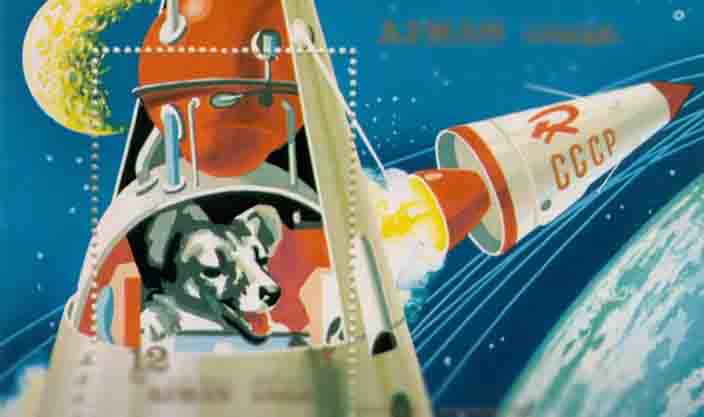
Laika: A journey that was a death sentence
From the beginning, her journey was a death sentence disguised as scientific progress. It is said she survived for seven hours, though some sources claim she lived a few days longer. Alone, exiled in the silence of space, she floated inside a metal capsule, unaware of why she had been taken, while the Earth spun below her, growing farther and farther away. She completed 2,570 orbits around the planet. Then, on April 14, 1958, the capsule re-entered the atmosphere and disintegrated, consumed by heat, gravity, and oblivion.

Laika never asked to be our heroine. She did not choose to represent science, the space race, or human progress. She was simply a stray dog with eyes that longed for love and a body that was used as a tool. She reminds us that progress is not always innocent, and that many of our achievements were written with the pain of those who could not say “no.”
Soviet Space Agency
As long as someone tells her story truthfully, her memory will live on not as an experiment, but as a testimony to what must never be repeated.Before becoming a test subject for the Soviet Space Agency, Laika (in Russian Лайка, “she who barks”) was a stray. The choice of a stray was deliberate, since she would already be accustomed to cold and hunger and could better withstand the harsh conditions of the flight. Her first name was Kudryavka, meaning “little curly one,” and she was also called Zhuchka, or “little bug.”

Sputnik 2 was designed and built in haste, in just one month, after Soviet leader Nikita Khrushchev ordered that the satellite be launched in time for the 40th anniversary of the Russian Revolution on November 3, 1957. As a result, unlike later Soviet satellites, it was never designed for safe re-entry, and
Laika was doomed from the moment her journey began. The plan was for Laika to remain alive for ten days in orbit, fed with a nutrient gel, and then to be euthanized with poison placed in the gel she would eat on the tenth day. Sensors attached to her showed that she survived the launch, but her heart rate tripled from fear and returned to normal only after a long time.
Little space dog first victim in orbit
Shortly after Sputnik 2 successfully reached orbit, a failure occurred in the insulation and ventilation system. The temperature inside her cabin rose above 40 degrees Celsius. Because dogs cannot regulate heat through sweating, Laika died from a combination of heatstroke, exhaustion, and extreme stress within five to seven hours after launch, having completed four orbits around the Earth. Sputnik 2 burned up upon re-entering the atmosphere on April 14, 1958, after 2,570 orbits.
In addition to being the first living creature in orbit, Laika also became the first victim in orbit. Yet her flight proved that living organisms could survive launch and the conditions of space, providing the first data on how life behaves beyond Earth. Nevertheless, her trainer Oleg Gazenko said in 1998, “As time passes, I regret more and more what I did. What we learned from this mission was not enough to justify the death of the dog.”
Marvel Cosmo the Spacedog
Space dog later appeared on postage stamps in many countries, inspired the Marvel character Cosmo the Spacedog, and was immortalized in the Arcade Fire song “Neighborhood (Laïka)” from the album Funeral. Most importantly, she sparked an international discussion about animal testing. The indifference toward animal life during the frenzy of the space race was abandoned when the time came for humans. Laika in Greek