
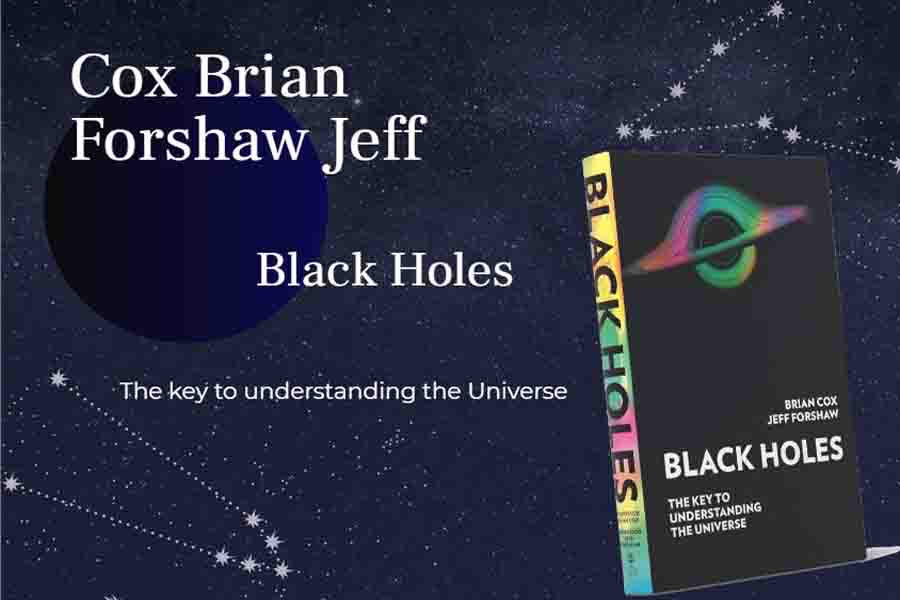
Brian Cox & Jeff Forshaw Black Holes – The Ultimate Quantum Laboratory: 1 Uniquely Groundbreaking Book
Brian Cox
Brian Cox is one of the most widely known and admired contemporary astrophysicists, an exceptional scientist who has succeeded in making physics accessible, compelling, and deeply inspiring to a broad audience. A Professor of Particle Physics at the University of Manchester, he has played a distinguished role in research at CERN’s Large Hadron Collider (LHC), where he participated in experiments probing the fundamental structure of matter and the forces that govern the Universe.
Born in 1968 in Oldham, England, Cox developed an early passion for both science and music. In his youth, he played keyboards for the band D:Ream, best known for the hit song “Things Can Only Get Better.” Although his musical career was successful, he ultimately chose science, completing his PhD in particle physics at the University of Manchester.
His research has focused on high-energy proton collisions and the phenomena that illuminate the origins of the Universe. Yet his international recognition extends far beyond the laboratory. Gifted with a rare ability to convey complex ideas with clarity, lyricism, and intellectual warmth, Brian Cox has become one of the world’s most influential communicators of modern physics.
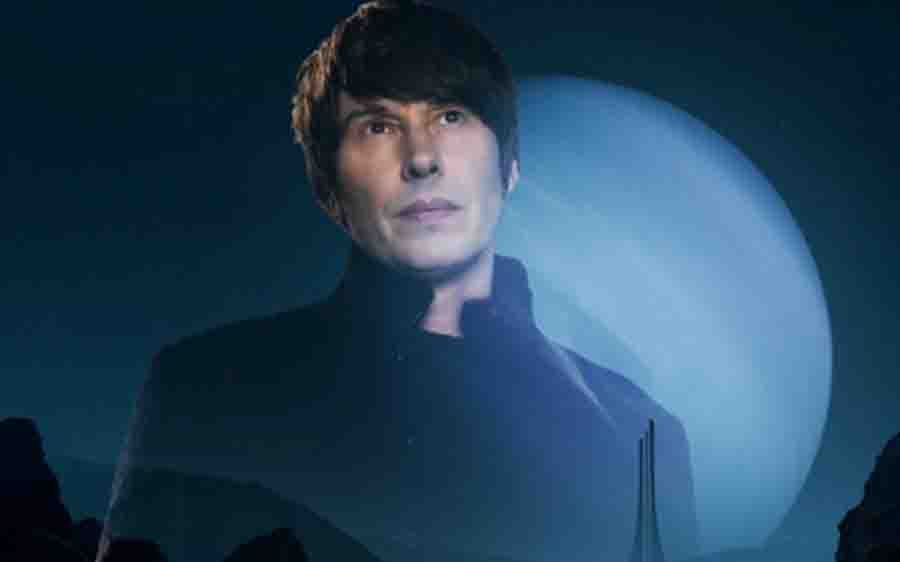
Through BBC television series such as Wonders of the Solar System, Wonders of the Universe, Forces of Nature, and The Planets, he has inspired millions to view the cosmos through the eyes of both scientist and philosopher. His style is unmistakable; poetic, optimistic, and profoundly humanistic. For Cox, science is not merely a method for understanding nature; it is a way of understanding our place within the Universe.
A Fellow of the Royal Society, he has received numerous awards for his contributions to science education and public engagement. Together with physicist Jeff Forshaw, he has authored a series of books that explain the deepest questions of physics with remarkable clarity and wit, from the nature of time and energy to the limits of spacetime and the mysteries hidden within black holes.
For Brian Cox, physics is a modern form of poetry: the art of seeking order and beauty within the chaos of the Universe. It is in this spirit that he approaches Black Holes – The Ultimate Quantum Laboratory, transforming one of the most challenging subjects in science into a gripping and elegant narrative.
Jeff Forshaw
Jeff Forshaw is Professor of Theoretical Physics at the University of Manchester. He specialises in particle physics and has worked extensively on quantum chromodynamics, the theory describing the forces that bind quarks inside protons and neutrons. His research contributes to our understanding of the interactions that shape matter at its most fundamental level.
Born in 1968, Forshaw studied physics at the University of Oxford before completing postgraduate studies at the University of Manchester, where he later became a professor. Passionate about teaching and science communication, he is renowned for his ability to explain highly complex theoretical ideas with logical clarity and intellectual precision. He has received numerous awards for excellence in education and public engagement with science.

In Black Holes – The Ultimate Quantum Laboratory, co-authored with Brian Cox, Forshaw combines mathematical rigour with the philosophical depth of physics. He explains with striking clarity how concepts such as the event horizon, the curvature of spacetime, and quantum fluctuations of the vacuum connect to humanity’s quest to understand the fate of the Universe.
Like Brian Cox, Forshaw believes that science is inseparable from society, it is the deepest expression of human curiosity. Teaching physics, for him, is an act of intellectual freedom, helping people see the world not as distant or inaccessible, but as something that can be understood through patience, imagination, and reason.
Together, Cox and Forshaw have inspired a new generation of students and readers to connect mathematics with the story of the Universe, demonstrating that physics is not just equations, but a narrative: the story of matter, space, and time.
Black Holes – The Ultimate Quantum Laboratory: A Uniquely Groundbreaking Book

There are moments in the history of science when the Universe seems to lower its voice and whisper its darkest secret. That whisper is the black hole, a region where spacetime is distorted, light is trapped, energy radiates from the vacuum, general relativity reaches its limits, and quantum physics steps forward to reveal its true nature.
In this captivating book, two leading physicists, Brian Cox and Jeff Forshaw, take us where few have dared to go: to the point where gravity meets quantum entanglement, where information challenges its own existence, and where the keys to a final theory of the Universe may lie. This is a journey into nature’s most extreme quantum laboratory: the interior of a black hole, the one place where an eternal traveler can truly “hear” nature speak in quantum terms.
What happens at the event horizon?
Can information be lost?
How does entanglement “build” space itself?
Could wormholes be gateways to other universes?
And why do many scientists now believe that quantum gravity might be studied… inside a quantum computer?
This is a book that reads like an adventure yet is built from pure science. You don’t say you’ve read it, you say you’ve experienced it. And once you close it, the night sky will never look the same again.
What Is a Black Hole, Really? Brian Cox
A cosmic monster or nature’s secret computer?
For an entire century, we believed that the Universe was made of a small number of fundamental particles interacting within a spacetime framework governed by elegant mathematical laws, so simple they could be written on the back of an envelope.
The study of black holes now seems to be pointing us in a new direction, toward a language more familiar to quantum computing scientists: the language of information. Space and time may not be fundamental at all; they may emerge from entangled quantum bits, assembled much like an exquisitely designed computer code. If the Universe were designed, its creator might appear to be… a programmer.
But caution is needed. As with William Paley before us, we risk being misled by our own sense of awe. The role of information theory in understanding black holes may lead us to a radical new description of nature, but this does not mean we are products of programming. Rather, it may simply mean that the language of computation is extraordinarily well suited to describing the algorithmic way in which the Universe unfolds.
Information processing, the flow of bits from input to output, is not an invention of computer science; it is a property of the Universe itself. Perhaps the idea of “spacetime as quantum code” does not point to a transcendent programmer, but instead reflects the fact that our computers are finally discovering the tricks nature has been using all along.
Seen this way, black holes become cosmic Rosetta Stones allowing us to translate our observations into a new language that reveals something of the deepest logic and most dazzling beauty of the Universe.
Does living in a Universe that resembles a giant quantum computer mean we are virtual beings trapped in the game of a superintelligent mind? Probably not. There is no need for such a leap. What is more likely is that, in our quest to formulate a quantum theory of gravity, the bluest of theoretical horizons, we have glimpsed a deeper layer of reality. And that insight may prove invaluable in designing the quantum computers of the future.
History has shown this pattern many times: we discover techniques long used by nature, and those techniques turn out to be profoundly useful. Nature, in the end, is the greatest teacher.
This unexpected connection between quantum computing and quantum gravity opens thrilling new possibilities. The future of quantum gravity research may gain an experimental dimension—something that, until recently, seemed unthinkable. One day, we may study the physics of black holes in the laboratory using quantum computers.
What began as pure theory, the unification of quantum mechanics and gravity, now appears poised for experimental testing through technology inspired by the theory itself. Black hole theory inspires quantum computing, and quantum computing may, in turn, test black hole theory.
This is the ultimate vindication of curiosity-driven research: two of the greatest challenges in science and technology have turned out to be deeply connected. The challenge of building a quantum computer mirrors the challenge of formulating the correct theory of quantum gravity. And that is why it is vital to continue supporting even the most “abstract” theoretical research. No one could have predicted this connection.
“Once you realise the stars and the infinity of the sky, life, after all, seems enchanted,”
wrote Vincent van Gogh.
The study of black holes has drawn some of the greatest physicists of the last hundred years, because physics is a search for both understanding and wonder. That our attempt to comprehend the infinite sky has led us to a holographic Universe, strange, logical, and breathtakingly beautiful, only confirms van Gogh’s intuition. When humans explore the transcendent, they inevitably encounter wonder. And, here lies the miracle of science, that wonder turns out to be profoundly useful.
— Brian Cox
Find the original Brian Cox & Jeff Forshaw Black Holes – The Ultimate Quantum Laboratory article in Greek on thermaiko.eu.
Fascinated by our article on Brian Cox & Jeff Forshaw’s book Black Holes? Explore more cultural content.