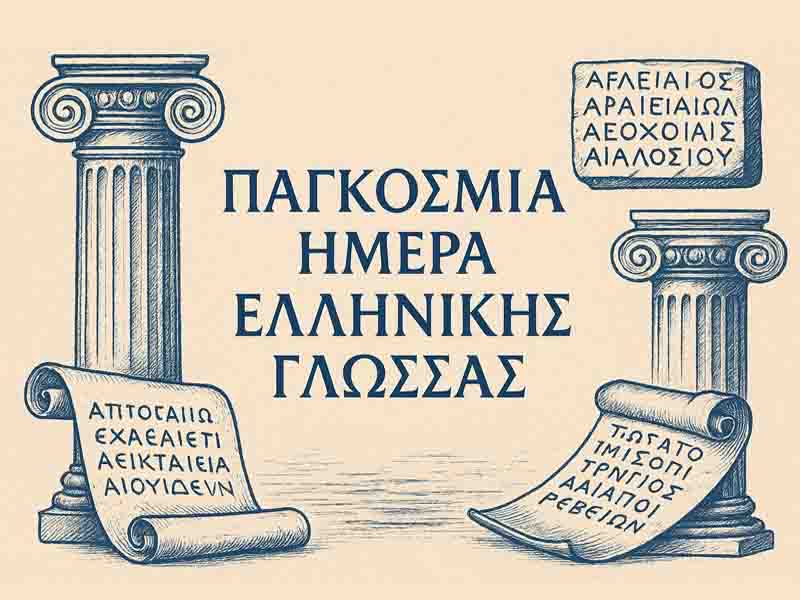
World Greek Language Day 9 Feb – A Celebration That Unites Us
9 February is dedicated to the Greek language, a language that is not merely a means of communication, but a bearer of memory, culture, identity, and creativity. This day was established to honour the global contribution of the Greek language and to remind us that, despite the changes of the centuries, it remains alive, evolving, and profoundly human.
A language that traveled through time
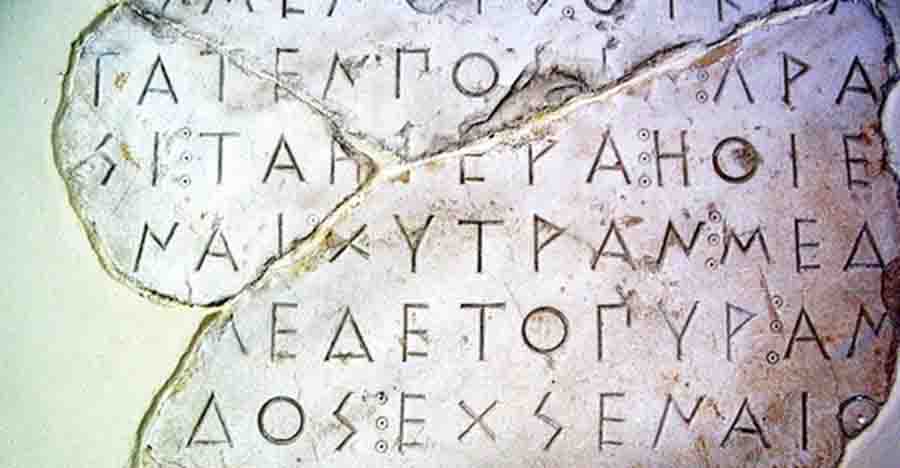
The Greek language has an uninterrupted history of more than three millennia. From the Homeric epics and the philosophy of classical Athens, to the Gospels, learned Byzantine literature, and modern Greek writing, it has served as the vehicle for ideas that shaped Western civilization.
It is no coincidence that words such as democracy, philosophy, culture, harmony, and logic have traveled into languages all over the world. Greek was never a closed language; it always opened new paths.
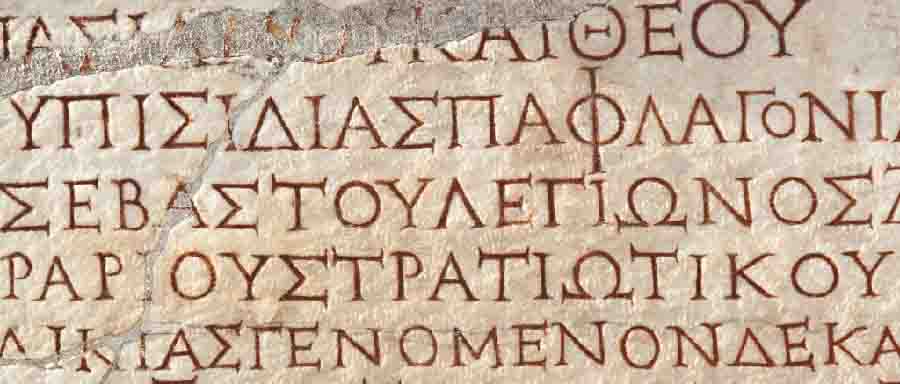
Language as identity and everyday life
For the Greeks, language is more than a heritage. It is the way they think, the way they express emotion, the way they create. It is the grandmothers’ words, the songs they grew up with, the stories passed down from generation to generation. In Greece, a place with deep roots and a rich oral tradition, the Greek language still carries the sounds of the neighbourhood, friendship, and the sea. It is the language that brings people together, giving colour to the small and great stories of everyday life.
The Greek language today
Despite the challenges of our time, the Greek language continues to evolve. New words are born, others change meaning, and technology opens new paths of expression. Language is not a museum; it is a living organism. Schools, universities, Greek communities abroad, and cultural institutions around the world honour the Greek language by teaching it to thousands of people who learn it out of love, curiosity, or cultural interest.
Why it matters to celebrate it
World Greek Language Day is not simply an anniversary. It is a reminder that the Greek language is a source of strength. It unites us, inspires us, and gives us the tools to create and to dream. It is an opportunity to remember that every word we write or speak continues a story thousands of years old while at the same time opening the way for the stories of tomorrow.
How World Greek Language Day was established
In a region where tradition meets modern life, the Greek language remains a common ground. From schools and cultural activities to gatherings on the beach and the stories of older generations, the language is the way we keep the identity alive. Let’s celebrate it, not only today, but every day, with respect, with love, and with creativity.
World Greek Language Day is celebrated every year on 9 February, a date that coincides with the anniversary of the death of Dionysios Solomos (1857), Greece’s national poet. The choice of this date is symbolic, linking language with freedom, poetry, and national identity.
The initiative to establish the day began in 2014 by the Federation of Greek Communities and Brotherhoods in Italy, inspired by Professor Giannis Korinthios. Classical high schools and the Greek Community of Naples and Campania played a leading role. Initially, 20 May (the presumed birth date of Socrates) was proposed, but 9 February was ultimately chosen following a proposal by cultural management advisor Ilias Bountouris.
The day was officially established in 2017 by a Joint Ministerial Decision of the Greek Ministries of Interior, Foreign Affairs, and Education (Government Gazette 1384/B/24-4-2017). In 2025, UNESCO internationally recognised the day during its 43rd General Conference in Samarkand. Greece’s proposal was supported by 90 member states, and 9 February was designated as a global day of cultural significance, highlighting the contribution of the Greek language to global thought, science, and democracy.
Read the original World Greek Language Day article in Greek on thermaiko.eu.
Or check our article about International Archaeology Day.